
 Image 1 of 3
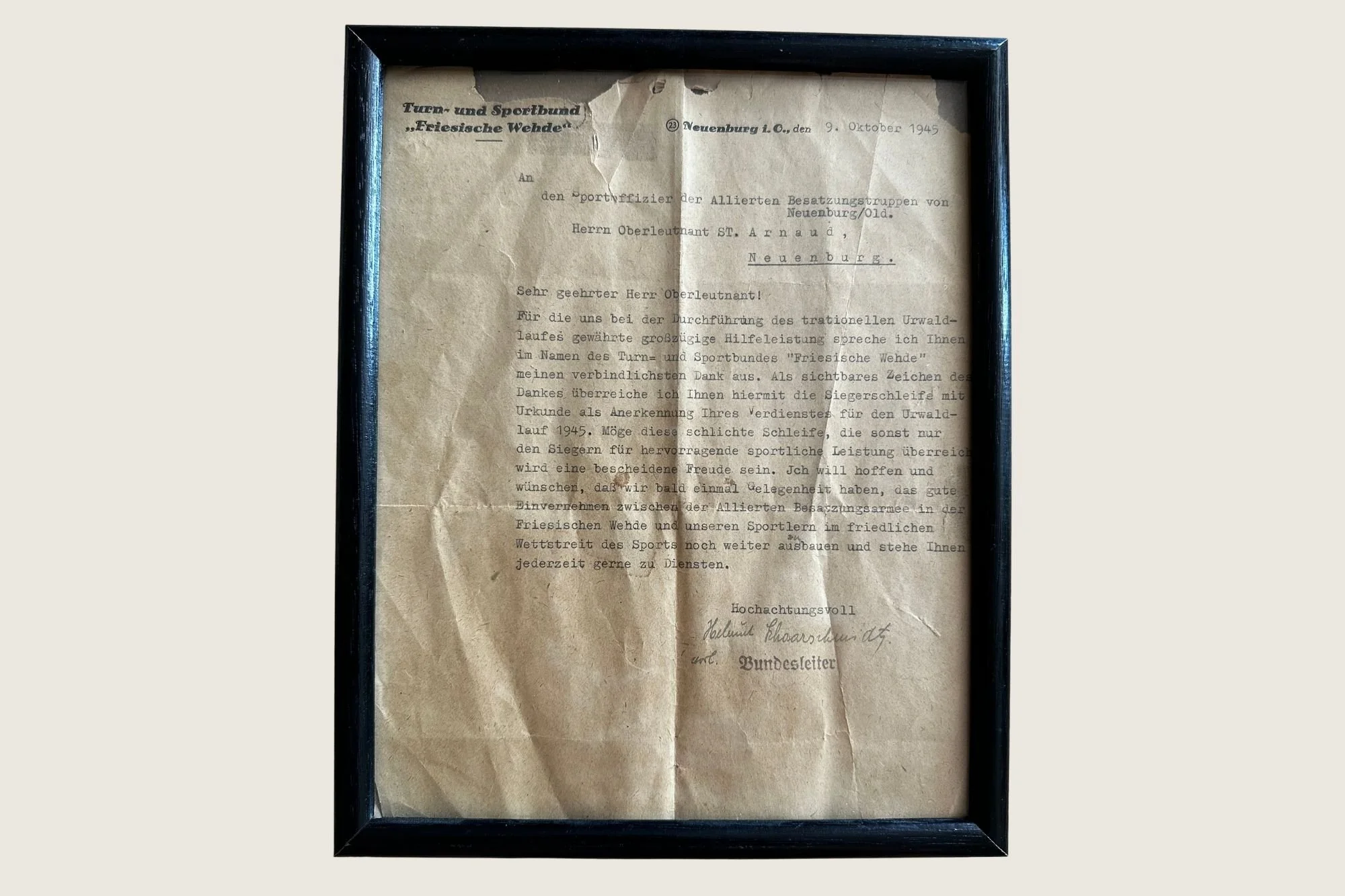 Image 2 of 3
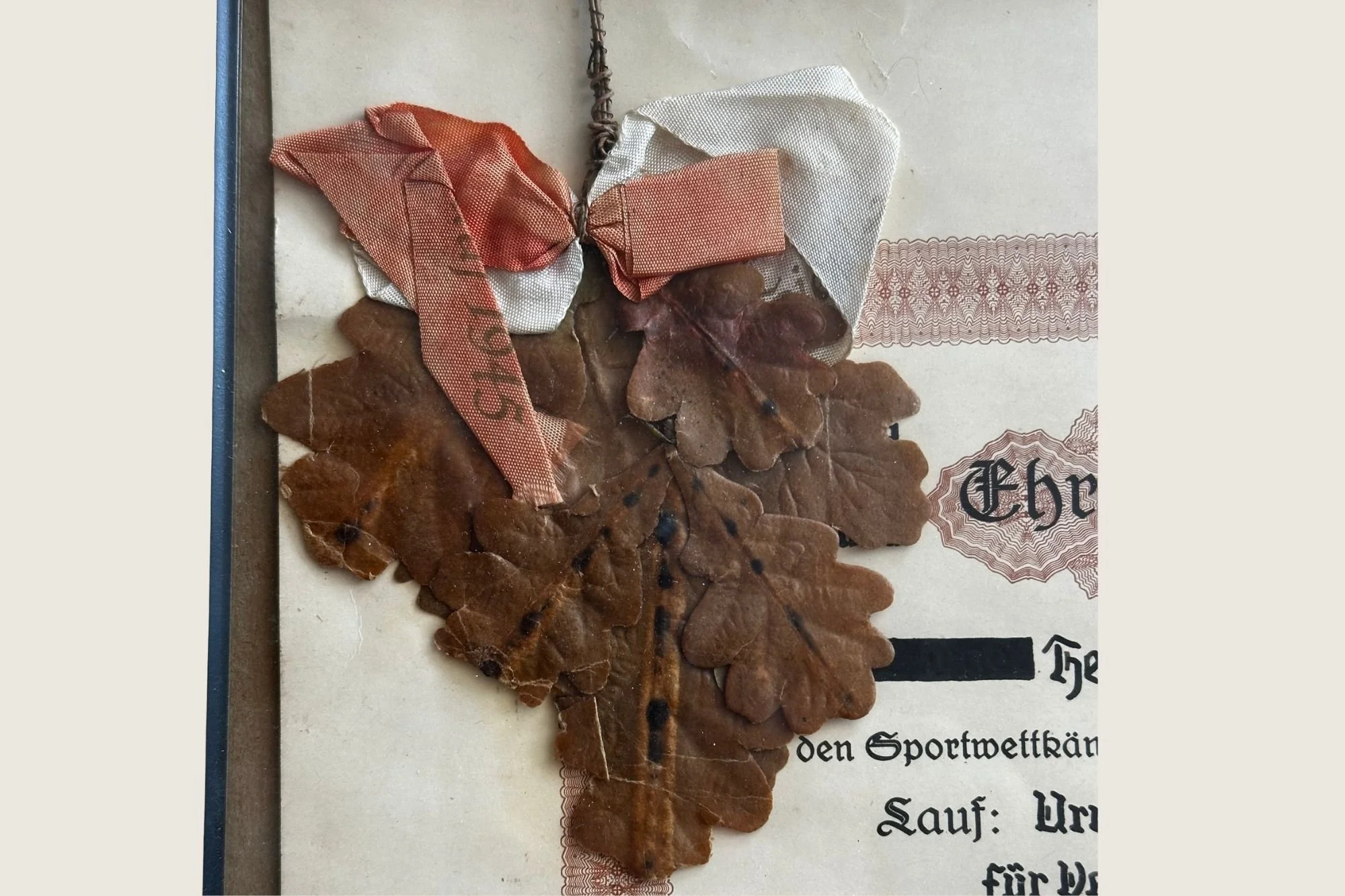 Image 3 of 3
-
The Urwald Villages Relay was held on September 23, 1945, only 138 days after the end of the war in Europe. At that moment, Allied troops remained in Germany as occupiers and local civic life was only beginning to re-form.
The documents do not describe a formal reconciliation program. They record something smaller and more immediate: a local German association working with an Allied officer to restore a traditional community sporting event.
The October 9 letter makes that meaning explicit. Its writer hoped that peaceful athletic competition would deepen the good understanding developing between the occupation forces and local sportsmen. The group therefore survives as unusually early evidence of civilian contact during the transition from defeat and military occupation toward ordinary public life.
-
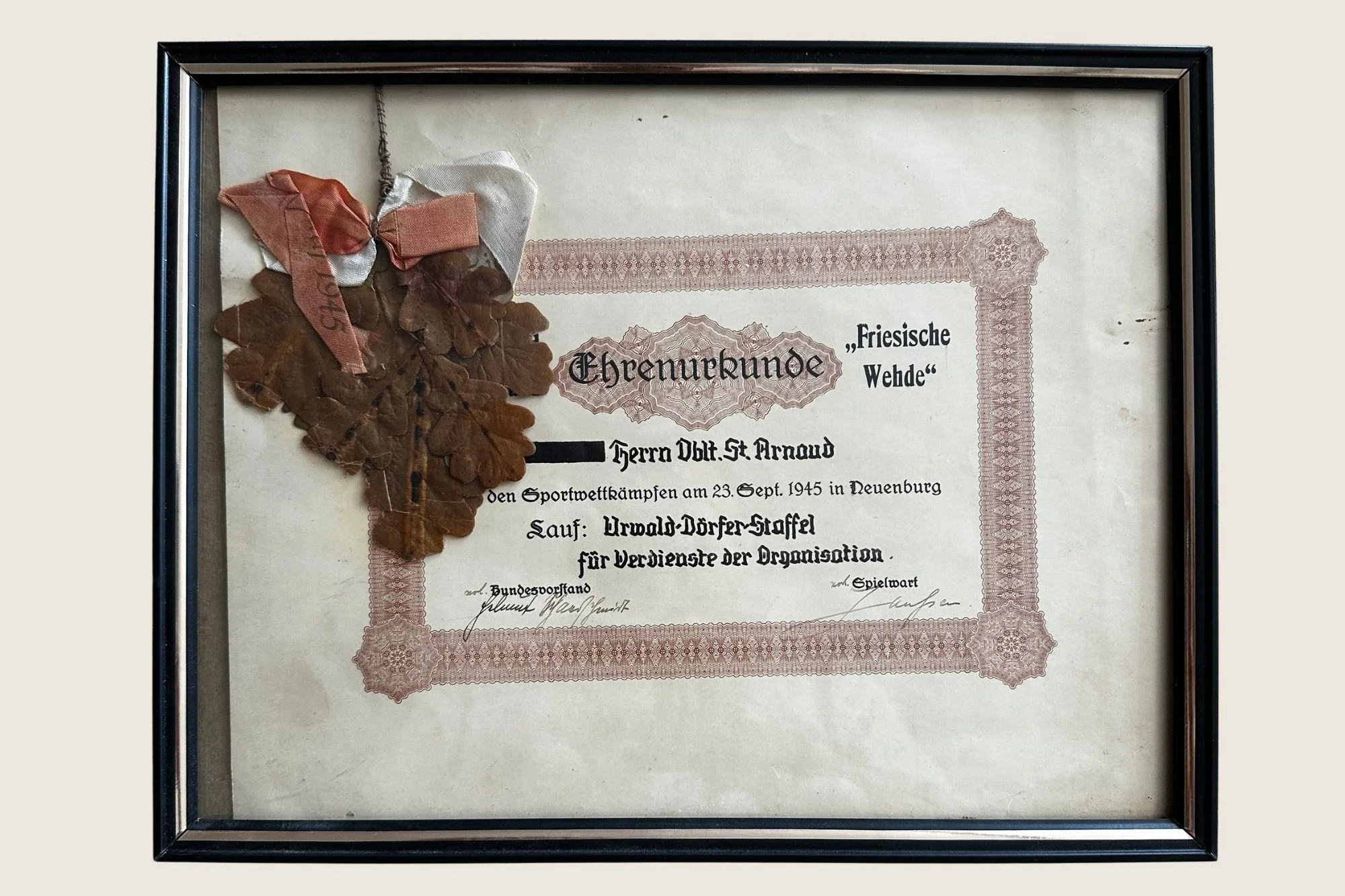
The certificate identifies the event as the Urwald-Dörfer-Staffel, or Urwald Villages Relay, held as part of sporting competitions at Neuenburg. “Urwald” refers here to the nearby Neuenburger Urwald and the surrounding Friesische Wehde region, rather than simply to a generic forest.
The presentation letter describes the attached textile as a Siegerschleife—a winner’s ribbon—and states that it was normally reserved for athletes of outstanding achievement. St-Arnaud received it in recognition of his organizational assistance rather than as a competitor.
The faded ribbon and preserved oak leaves are therefore not later decoration. They are the physical presentation elements explained by the accompanying letter. Their fragility is a conservation concern, but their survival gives the group an unusual material completeness.
-
The recipient is attributed with high confidence to George F. St-Arnaud (1921–2009), a Canadian Second World War veteran who later worked for Johnson & Johnson until his retirement in 1986.
The identification rests on several converging details. The documents name St-Arnaud and place him with Allied occupation troops in Germany in 1945. They were later found in Quebec with other St-Arnaud material, reportedly including a Johnson & Johnson certificate. George F. St-Arnaud’s obituary independently confirms both his military service and his later career with that company.
The strongest military hypothesis is that he served with, or was attached to, the 3rd Battalion, Le Régiment de la Chaudière, which was mobilized specifically for Canadian occupation service in Germany in June 1945. No officer roll or service file currently confirms that assignment, so the unit connection remains plausible rather than established.
-
The following is a faithful English translation of the original German letter. Paragraph breaks have been added for readability. The handwritten signatory has not been identified; the title beneath the signature appears to mean “Acting Association Leader.”
Gymnastics and Sports Federation
“Friesische Wehde”
Neuenburg in Oldenburg, October 9, 1945
To the Sports Officer of the Allied Occupation Troops in Neuenburg, Oldenburg
First Lieutenant St. Arnaud
Neuenburg
Dear First Lieutenant,
For the generous assistance extended to us in conducting the traditional Urwald race, I wish to express to you, in the name of the Gymnastics and Sports Federation “Friesische Wehde,” my most sincere thanks.
As a visible token of our gratitude, I hereby present you with the winner’s ribbon and certificate in recognition of your contribution to the 1945 Urwald race.
May this simple ribbon, which is otherwise presented only to winners for outstanding athletic achievement, bring you a modest measure of pleasure.
I hope and wish that we will soon have an opportunity to further develop the good understanding between the Allied occupation army in the Friesische Wehde and our sportsmen through peaceful sporting competition.
I remain gladly at your service at any time.
Respectfully,
[signature]
Acting Association Leader